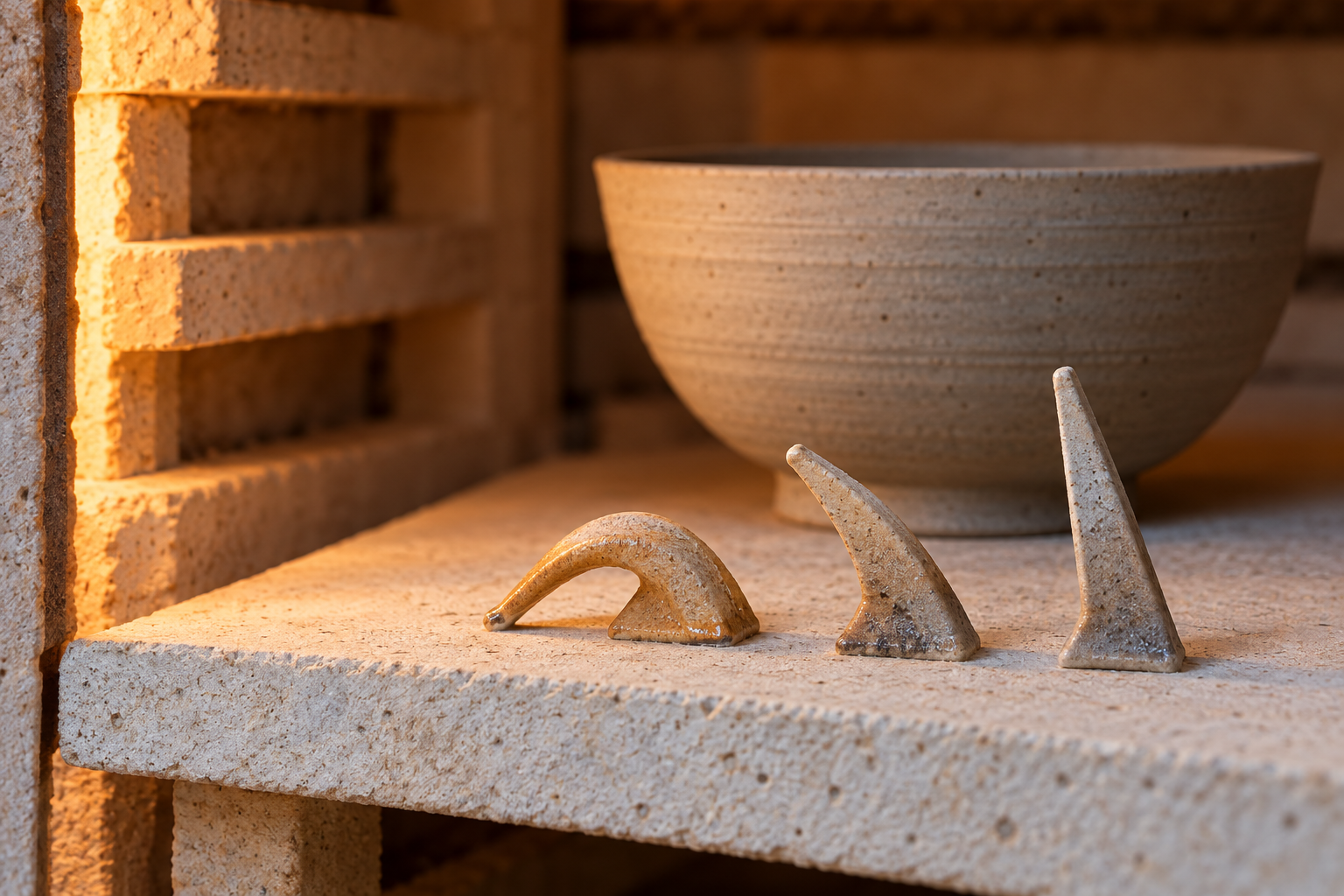
After a kiln has cooled, the most informative object on a shelf may be the smallest one. A witness cone, once a pointed ceramic pyramid, now leans toward the shelf. Another cone beside it has bent only partway. The controller has its record of the firing, but these little shapes have a different one: what happened to a calibrated piece of ceramic where the pots were sitting.
The distinction matters because a firing does not have one perfectly representative temperature. Heat reaches different shelves at different rates, and a load of bowls can change how it moves through the chamber. A thermocouple tells the controller about the temperature at its own tip. The cone responds on its shelf. Its bend is evidence from that position, though it is evidence with limits.
A bend made by heat and time
A witness cone is made from a controlled ceramic mixture. As it is heated, some of its material forms glass; the cone softens, and gravity pulls its narrow tip down. The composition and shape are designed so the bend is repeatable under defined conditions. In a 2019 materials study, Peter Hsieh modelled how temperature differences within a cone and the changing viscosity of its partly molten material help determine its deformation. This is a physical response, not a tiny clock hand mechanically turning to a preset mark.
Potters call the accumulated effect heatwork. Temperature matters, and so does the time spent hot enough for the material to change. The Orton Ceramic Foundation's 2016 cone chart says this plainly: cones do not measure temperature alone. They bend at a higher endpoint temperature when a kiln heats quickly and at a lower one when it heats more slowly. A hold near the top of a firing adds time at high temperature and can bend a cone further without raising the displayed peak.
There is a useful number behind that idea. In Orton's chart, a self-supporting cone 6 reaches its specified bend at 1222°C when the final 100°C of the firing rises at 60°C an hour. At 150°C an hour over that final interval, the listed endpoint is 1243°C. The same cone number and endpoint therefore correspond to temperatures 21°C apart under those two specified test rates. These are chart equivalents from controlled firings in air, not two universal shutoff settings for every kiln.
This is why “cone 6 is 1222°C” is a convenient shorthand with a missing clause. The heating rate, cone shape and mounting have to be known before a chart temperature means much. Even the difference between cone 06 and cone 6 is substantial: the leading zero belongs to a lower-temperature series. The L&L Kiln Dura-Fire manual warns that dropping it can lead to serious overfiring. A small character on a bag or controller can be more consequential than it looks.
What the cone says beside the pots
A single cone can tell you whether its position received enough heatwork to bend that particular composition by a particular amount. It cannot give you a continuous history of the kiln. The final shape is what remains after many different possible paths through the firing. A slow approach and a brief hold might produce a similar bend to a faster approach and a higher peak. The cone preserves an outcome, not every step that produced it.
Reading that outcome takes more care than looking for a collapsed tip. Orton's chart defines its standard endpoint as a 90-degree bend, roughly the tip at five o'clock if the standing cone began near one o'clock. The tip touching the shelf is around six o'clock; close to the endpoint, quite a large visual change can represent only a few degrees in the chart's controlled conditions. A cone that has fallen flat has passed the point where its shape gives much finer information. The difference between “nearly there” and “there” is easier to judge with the manufacturer's cone-measuring template or a consistent photograph than with memory alone.
The mounting matters too. The 2016 chart gives different equivalent temperatures for self-supporting, large and small cones, and specifies how high each should stand above its base. A self-supporting cone supplies its own angle and height; a large cone in a plaque must be mounted consistently. If one leans before firing and the next stands at the intended angle, comparing their finished bends as if nothing changed invites a false diagnosis.
One cone can also be lonely evidence. A common practice is to set out three in sequence: a guide cone that bends first, the target cone, and a guard cone that should need more heatwork. The L&L manual explains this arrangement for test firings. For a cone 6 target, the neighbouring cones would be 5 and 7; for cone 06, they would be 07 and 05. The zero series runs in the opposite numerical direction. The set gives the target bend context. If the guide is down but the target is still high, the shelf has approached the intended heatwork. If the guard has bent strongly as well, the target may have received more than planned.
Place sets at several useful positions and the cones become a rough map. In its 2016 KilnMaster operating manual, Skutt recommends shelf witness cones even with a programmed controller and discusses comparing them with the thermocouple response. A top shelf whose target cone bends farther than the bottom shelf's may have received more heatwork in that firing. Repeat the same placement over several loads and a pattern may emerge. A single difference is a reason to look closer at loading, element condition, venting and firing schedule, rather than proof of one specific fault.
The idea of distributing cones through a kiln is old. In a March 1927 Bureau of Standards report, researchers described using them in different kiln positions and reported that a cone's softening temperature depended on both heating rate and surrounding gases. That finding remains a good warning against treating the number printed on a cone as a naked temperature reading.
The questions it cannot answer
A cone can witness its local heating conditions, but it cannot tell you whether a glaze will be durable, whether a body has the desired absorption, or whether a surface colour pleases you. Those questions belong to the particular clay and glaze, their tests and the fired pots. Materials assigned the same cone range can still respond differently. The witness cone is a comparator, not a certificate of maturity for everything beside it.
Nor does a finished bend describe the whole journey. It will not tell you exactly when moisture left a thick piece, whether gases escaped cleanly from a glaze, or how slowly the kiln cooled through a crystal-forming range. Those stages can matter to the result even when two firings leave similar target cones. The controller's schedule, a firing log and the ware itself carry other parts of the story.
Atmosphere adds another complication. Orton notes that reducing conditions can change the behaviour of certain iron-bearing low-temperature cones, particularly its red cones numbered 010 through 3, and recommends its iron-free series for reduction firings in that range. A cone exposed to an atmosphere unlike the one used for the chart may be harder to compare with the printed equivalent temperature. That is a reason to choose the appropriate cone and read its maker's guidance, especially in gas firing.
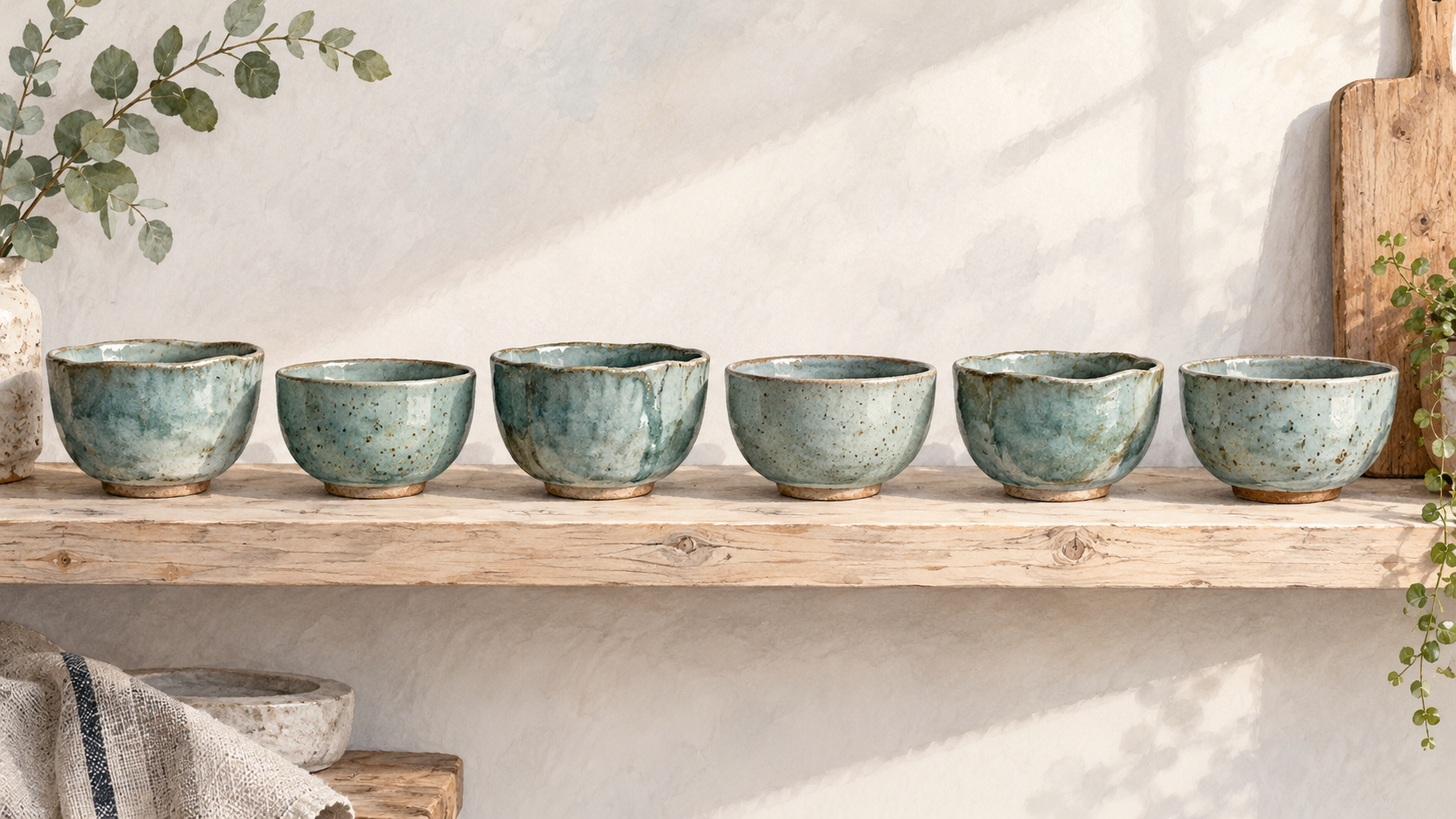
The most useful habit is modest. Note which cone went on which shelf; after the kiln is cool, photograph the set with its position and firing program. Look at the cone alongside the surfaces and shapes of the pots. If a shelf repeatedly fires hotter than another, those small crooked records can help guide a controlled change and show whether it worked. They make a firing visible at the place where the work actually sat. That is enough to earn them a spot beside the bowls.

A thought worth keeping?