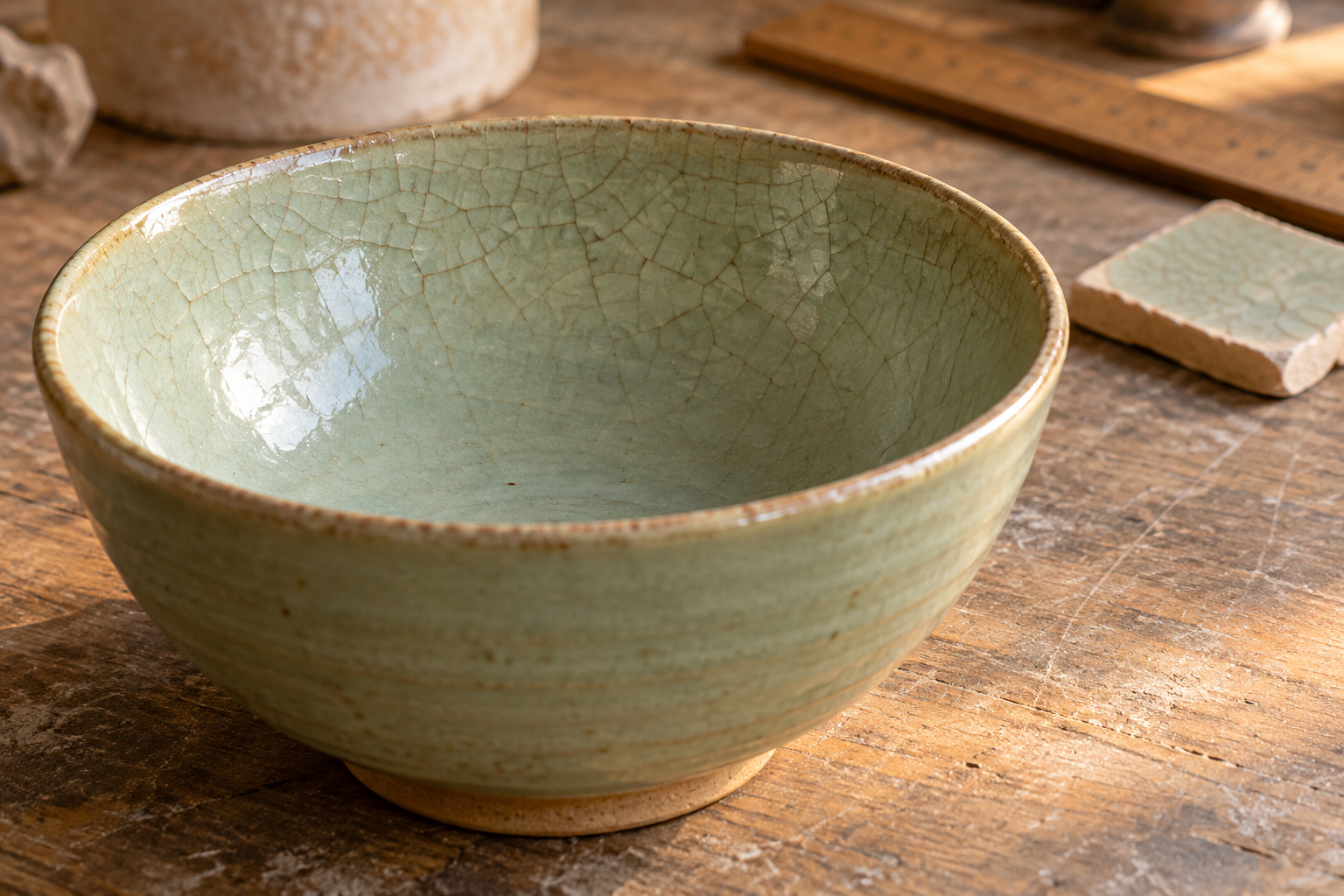
A glazed pot can leave the kiln looking smooth and show a web of fine lines days later. The lines are crazing: cracks in the glaze layer. Their late appearance makes the last wash, the room's damp air or an ordinary change of temperature look like the sole cause. The more useful question is what state the glaze was in when the pot first cooled, and what changed after that.
The glaze and the fired clay body are joined, but they are different materials. They contract on cooling and can respond differently to moisture later. Crazing begins when the glassy coating is pulled into enough tension to crack. That tension may become large during cooling, or a pot may leave the kiln with a narrower margin and cross it later. A delayed crack is therefore not evidence that the pot was free of strain yesterday.
The fit is made during cooling
At firing temperature a glaze has melted onto the body. As it cools and becomes rigid, it can no longer flow freely to accommodate every change in size below it. If a particular glaze tends to contract more than its body over the relevant cooling range, the body holds it stretched. The resulting tensile stress can break the glaze into a fine network. The reverse mismatch can put the glaze under compression, which usually resists crazing up to a point.
This is a relation between a particular glaze and a particular body, not a virtue or fault that belongs to either material alone. In experimental work on deliberately crackled glazes, Plešingerová and Kovalčíková measured expansion of both materials and related their difference to crack density. They found that sufficient tensile stress produced the desired net during the final part of cooling. Their tests also showed that a surface cooling faster than the body could temporarily increase stress. Cooling history matters, but a slower cool does not turn an unsuitable expansion match into a suitable one by itself.
There is physical evidence behind the language of “tension.” In measurements on porcelain tableware, Hiroshi Inada used optical stress measurements on cut samples. Every crazed piece in his examined set had a glaze under tension. Some pieces without crazing also had tensile glaze. That distinction matters: a strained surface can survive for now, while a crack's absence at the kiln opening does not prove good long-term fit. Inada's data concern the porcelain wares he tested, rather than a universal stress threshold for all clays and glazes.
A second clock starts after firing
Some fired ceramic bodies change size when they take up moisture during storage or use. If the body expands more than the glaze above it, the glaze is stretched further. A coating that held together at room temperature can then craze later without any dramatic new event. In 1928 experiments on delayed crazing, H. G. Schurecht found that expansion of the ceramic body explained many such cases and used pressurized steam to bring out the tendency in test pieces. The paper said many, not all: the visible timing alone does not diagnose the mechanism.
The later change has also been watched on prepared ware rather than only inferred from old pots. In the 2003 glaze experiments, the researchers examined cold specimens shortly after firing and again after seven and fourteen days. On one moisture-expanding body, glazes that had shown no immediate cracks developed additional fine lines over the following days. Their controlled bodies and glazes do not set a timetable for an ordinary mug, but they show how a finished-looking surface can keep changing.
“Porous body expands” is a useful start, not a complete test. In a National Bureau of Standards study of body compositions, Schurecht and G. R. Pole soaked and steam-treated fired bars, then measured their length. Greater absorption often went with greater expansion within a given composition, yet different compositions broke a simple rule: some bodies with relatively low absorption still expanded appreciably. Firing temperature and the ingredients left in the fired body mattered. A water-absorption figure cannot, on its own, tell a maker whether a specific glaze will stay intact.
Nor is the glaze always perfectly motionless when moisture arrives. In a subsequent Bureau study of ceramic finishes, Schurecht and Pole measured small moisture expansions in several glazes and slips. A finish that expanded more nearly with its body could reduce the extra tension produced by the body's growth. The important quantity is the difference in their behavior. Those laboratory steam treatments accelerated a process; they did not predict the exact day a particular pot would show its first line.
Why a crackle glaze is a different choice
Crackling can be intentional. The 2003 researchers designed decorative craquellé by making a tensile glaze-body combination produce a visible network. The same material principle that makes the pattern attractive on an art object can make an unplanned network a defect on ware meant to remain smooth. In their samples, the cracks reached the body and could admit liquid. Appearance alone should not be mistaken for a sealed surface.
The answer is not to push the glaze into as much compression as possible. In a Bureau of Standards ring-test study, Schurecht and Pole compared the strain in fired glaze-body pairs by cutting glazed rings and measuring how they moved. Modest compression helped resist later crazing; excessive compression could cause shivering, in which glaze loses its hold and chips away. Their test was a way to assess the pair, not a magic expansion number that could be applied to every vessel.
For a maker, the sensible unit of investigation is the whole fired combination: body, glaze, application and firing schedule. Look at a test piece when it is cool, then again after it has lived through the conditions the finished ware will meet. A controlled moisture or thermal test may expose a poor fit sooner, but its result needs to be read as evidence about susceptibility, not as a calendar. The first craze line may appear long after the kiln has gone cold; the fit that made it possible began much earlier.

A thought worth keeping?